Successful Data Recovery from a 14-Drive RAID System with Unknown Drive Order
Some of the most challenging data recovery cases involve large RAID storage systems. This particular case was one of those recoveries.
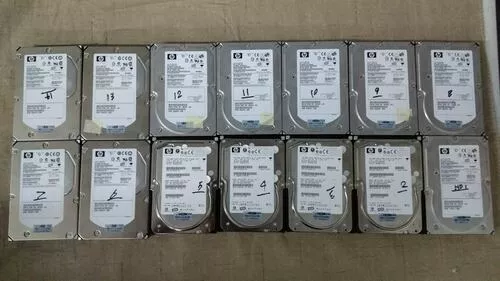
We received a 14-drive RAID array after the storage system had failed. Recovering data from a RAID is already considerably more complex than recovering data from a single hard drive, but this case presented an additional challenge that significantly increased the complexity: the drives had been removed from the system and shuffled out of their original numbered order before they arrived for recovery.
Despite these obstacles, we successfully reconstructed the RAID configuration, determined the original drive order, identified the sequence of drive failures, and recovered the customer's data.
How RAID Systems Protect Data
RAID, which stands for Redundant Array of Independent Disks, combines multiple hard drives into a single storage system. Depending on the RAID level, the system may improve performance, increase storage capacity, provide fault tolerance, or accomplish a combination of these goals.
One of RAID's biggest advantages is redundancy. Certain RAID configurations allow one or more hard drives to fail without immediately losing access to the stored data.
However, every RAID level has limits. Once too many drives fail, or if critical information becomes inconsistent, the array can become inaccessible even though much of the data still physically exists on the individual drives.
The number of drives that can fail depends entirely on the RAID configuration. Some RAID levels tolerate a single failed drive, while others can survive multiple failures. If those limits are exceeded, professional reconstruction is often required.
The Drives Arrived Out of Order
Perhaps the biggest challenge in this recovery was that the drives were no longer in their original positions.
Large RAID systems rely on every drive occupying a specific location within the array. The operating system expects data to be distributed across the drives in a precise pattern. Simply changing the order of the drives can make an otherwise recoverable RAID appear completely unreadable.
Unfortunately, before the system arrived for recovery, the drives had been removed and shuffled. The original slot numbers and drive order were no longer known.
Without the correct drive order, the RAID could not simply be rebuilt or mounted. The first step was determining exactly where each of the fourteen drives originally belonged.
Why Drive Order Matters
Unlike a single hard drive, a RAID stores pieces of every file across multiple drives. Imagine taking the pages of a book and distributing them among fourteen different binders. If those binders are placed back in the wrong order, the story no longer makes sense.
RAID systems work in a similar way. Every block of information is written according to a specific pattern based on:
- The original drive order
- The RAID level being used
- The stripe size
- The parity rotation (for RAID levels that use parity)
- The order in which drives failed
If even one of these elements is incorrect, the recovered data may become corrupted, incomplete, or completely unreadable.
Determining the Original Configuration
Recovering this RAID required extensive analysis of all fourteen drives.
Each drive was individually evaluated to determine its condition and to identify the data still available. We then analyzed the contents of every drive to reconstruct how the RAID had originally been configured.
This involved identifying:
- The original position of each drive within the array.
- The RAID parameters used by the storage system.
- Which drive had failed first.
- Which drive failed last.
- The sequence of failures needed to reconstruct the most current version of the data.
Determining the final failed drive was particularly important because it allowed us to recover the most recent version of the customer's data rather than an older state of the array.
A Methodical Reconstruction Process
Large RAID recoveries cannot be rushed. Before any data can be reconstructed, every assumption must be verified. An incorrect drive order or an incorrect failure sequence can invalidate an entire recovery attempt.
This case required extensive testing, comparison, verification, and reconstruction before the array could be assembled virtually.
Once the correct configuration had been identified, the RAID was reconstructed in software, allowing the file system to be accessed and the customer's data to be safely copied to separate storage.
A Successful Recovery
After determining the original drive order, identifying the RAID parameters, and reconstructing the array using the correct failure sequence, we successfully recovered the customer's data.
Considering the number of drives involved and the fact that the original drive order had been lost, this was an exceptionally satisfying recovery. Cases like this require not only specialized hardware and software, but also patience, careful analysis, and a thorough understanding of how complex RAID systems store data.
What to Do If Your RAID System Fails
If a RAID system becomes inaccessible, the steps taken immediately afterward can significantly affect the chances of a successful recovery.
- Do not shuffle or renumber the drives. Keep every drive in its original slot whenever possible.
- Label each drive before removal. Even handwritten labels can save many hours of reconstruction.
- Do not initialize or rebuild the array. Rebuilding onto the wrong drive or using an incorrect configuration can permanently overwrite recoverable data.
- Do not replace multiple drives without understanding the RAID status. The order in which drives fail can be just as important as the drives themselves.
- Avoid experimenting with RAID settings. Changing stripe size, RAID level, or other parameters can make recovery significantly more difficult.
- Have the system professionally evaluated. Determining the correct RAID configuration before making changes greatly improves the likelihood of recovering the most recent data.
One of Our Most Challenging RAID Recoveries
Every data recovery presents its own challenges, but some cases stand out because of the level of analysis and problem-solving they require. This 14-drive RAID was one of those cases.
Recovering data from a large RAID array is difficult enough when every drive remains in its original position. Receiving fourteen drives that had been shuffled out of order transformed an already complex recovery into a true forensic reconstruction exercise. Successfully determining the original drive order, identifying the sequence of drive failures, and reconstructing the array to recover the most recent version of the customer's data required many hours of careful investigation.
At PC Warehouse, we take great pride in cases like this because they demonstrate that successful data recovery is about much more than replacing failed hardware. It requires experience, specialized tools, persistence, and a methodical approach to solving complex storage problems. While no data recovery can ever be guaranteed, recoveries like this are a reminder that even when a RAID system appears impossible to reconstruct, there may still be a path to recovering the data.