100% Data Recovery from a Hard Drive Contaminated with Liquid Soap
This data recovery case involved a hard drive that had been extensively covered with liquid soap. The contamination was not limited to the outside of the drive. The soap reached the electronic circuit board and also found its way into the sensitive internal area of the hard disk assembly.
Liquid contamination inside a hard drive can create serious electrical and mechanical problems. In this case, the recovery required extensive component-level work, internal hard drive procedures, and parts from multiple compatible donor drives. After using nine donor drives, we were able to achieve a 100% recovery of the customer's data.
Soap Residue on the Hard Drive Assembly
The underside of the hard drive showed significant contamination around the printed circuit board and the exterior of the hard disk assembly, commonly referred to as the HDA. The visible residue demonstrated how thoroughly the liquid soap had covered the drive.
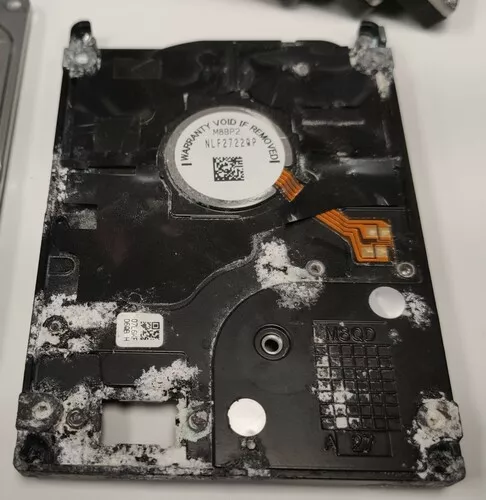
Image A: The PCB side of the hard disk assembly showing the remaining soap residue and contamination.
Although liquid soap may seem less harmful than plain water, it can be particularly difficult to remove. Soap contains chemicals and additives that may leave a conductive or corrosive residue behind after the moisture begins to dry. That residue can interfere with small electronic components, connectors, and electrical pathways.
Contamination Inside the Sensitive Area of the Drive
Hard drives are not designed to operate with foreign material inside their internal assembly. The read-and-write heads fly extremely close to the surfaces of the spinning platters. Even microscopic contamination can interfere with this process and cause damage.
During the evaluation, we found that the liquid soap had entered the sensitive internal area of the HDA.
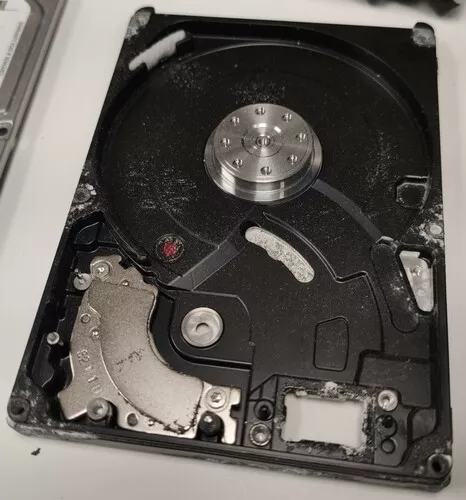
Image B: Soap contamination found inside the sensitive area of the hard disk assembly.
Internal contamination creates several potential complications, including:
- Damage to the read-and-write heads: Residue can collect on the heads and prevent them from reading the platter surfaces correctly.
- Contact with the platters: Contaminated or unstable heads may make contact with the magnetic surfaces and cause additional media damage.
- Unstable drive operation: The drive may repeatedly disconnect, stop responding, or produce read errors.
- Progressive damage: Continued attempts to operate a contaminated drive may spread residue and worsen the condition of the heads and platters.
- Electrical failure: Soap residue on the PCB or internal connections can cause corrosion, short circuits, or communication failures.
A Severely Damaged Circuit Board
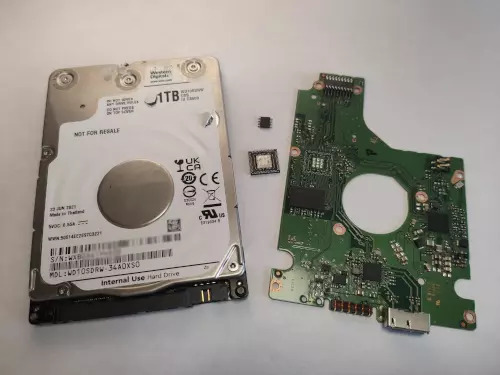
The hard drive's printed circuit board had also been damaged by the liquid contamination. The PCB controls communication, motor operation, power distribution, and other essential drive functions.
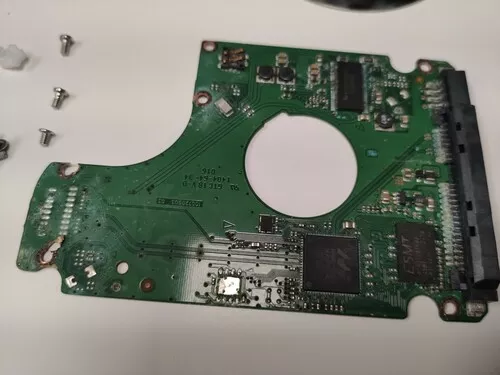
Image D: The damaged printed circuit board from the contaminated hard drive.
Replacing a hard drive circuit board is not normally as simple as installing a matching board from another drive. Modern hard drives often store unique adaptive information in a ROM chip or within the controller electronics. This information is specific to the original drive and may be required for the heads to correctly read the data stored on the platters.
As a result, compatible replacement electronics may need to be adapted using information preserved from the original PCB.
Why Multiple Donor Drives Were Required
A donor drive is a compatible hard drive used to provide replacement components during a data recovery procedure. Depending on the failure, a donor may provide a replacement head assembly, circuit board, internal component, or another part needed to temporarily restore access to the data.
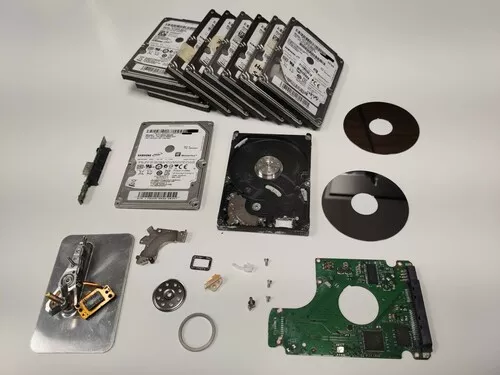
In this case, the contamination had caused severe and ongoing problems with the drive's internal components. Multiple replacement head assemblies were required as the recovery progressed. Altogether, parts from nine donor drives were needed to complete the recovery.
The need for several donors does not necessarily mean the recovery procedure was unsuccessful. In severe cases, replacement components can become damaged while reading contaminated or degraded platter surfaces. Each donor may provide another opportunity to recover additional sectors before the replacement components can no longer operate reliably.
Protecting the Replacement Head Assemblies
Hard drive heads are extremely delicate. They must be handled with specialized tools designed to keep the individual heads separated and properly aligned during removal, storage, and installation.
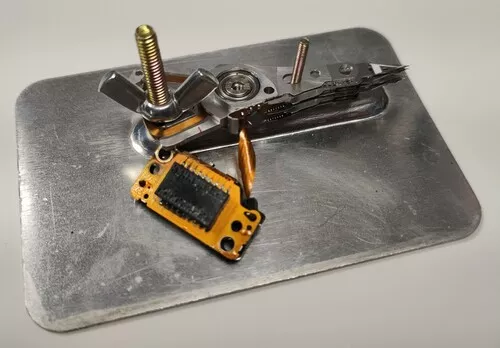
Image C: A specialized hard drive head storage tool used to safely hold the delicate read-and-write head assembly.
The head storage tool helps prevent the heads from touching one another or contacting other surfaces. Proper handling is especially important because even a small amount of physical contact can damage the heads before they are installed into the recovery drive.
The Data Recovery Process
Recovering the data required a carefully controlled process. The objective was not to repair the hard drive for continued use. Instead, the goal was to make the drive operational only long enough to create a stable sector-by-sector copy of the available data.
The procedure involved several stages:
- Evaluating the liquid contamination: We examined the PCB, exterior of the HDA, and sensitive internal components to determine how far the soap had spread.
- Addressing the damaged electronics: The failed PCB and drive-specific electronic information had to be handled before reliable communication could be established.
- Cleaning and preparing the internal assembly: Contamination had to be addressed carefully to reduce the risk of further damage during operation.
- Installing compatible donor components: Replacement parts from matching donor drives were used as needed throughout the recovery.
- Creating a sector-by-sector copy: Data was copied to separate storage rather than relying on the damaged drive for normal file access.
- Repeating the procedure when necessary: As replacement heads became damaged or unstable, additional donor components were required to continue reading the remaining areas.
- Reconstructing and verifying the data: Once the media had been copied, the recovered file system and customer data were examined for completeness.
A Complete 100% Recovery
Despite extensive soap contamination, a damaged circuit board, internal HDA contamination, and the need for nine donor drives, we were able to recover 100% of the customer's data.
This was an unusually difficult case that required persistence and multiple stages of recovery. It also demonstrates why a hard drive should not automatically be considered unrecoverable simply because it has been exposed to liquid or has already experienced multiple component failures.
What to Do When a Hard Drive Is Exposed to Liquid
The actions taken immediately after liquid exposure can have a major effect on the likelihood of a successful recovery.
- Disconnect the drive immediately. Remove power as soon as it is safe to do so.
- Do not attempt to power it on again. Electricity can cause short circuits and accelerate corrosion.
- Do not connect it to another computer or USB adapter. Additional power attempts can turn recoverable damage into permanent damage.
- Do not shake or rotate the drive. Movement may spread liquid into areas that were not previously contaminated.
- Do not open the HDA. Opening a hard drive outside of an appropriate controlled environment can introduce additional contamination.
- Do not use a hair dryer, oven, or direct heat. Heat may damage electronic components, distort internal parts, or leave additional residue behind.
- Keep the drive in its current condition. Place it in a clean, protective container and have it professionally evaluated.
Severe Liquid Damage Does Not Always Mean the Data Is Lost
A hard drive covered with soap may appear to be completely destroyed, particularly when the liquid has reached both the PCB and the internal components. However, the physical condition of the drive does not always determine whether the stored information can be recovered.
Every data recovery case is different, and no outcome can be guaranteed. This case demonstrates that with the proper equipment, compatible donor parts, careful handling, and a methodical recovery process, even an extremely contaminated hard drive may still yield a complete recovery.